
Resistors in📱 Introduction
Resistors are one of the most basic yet critical components used in mobile phone circuit boards.
Whether it’s charging, signal processing, or power management, resistors play a vital role in ensuring proper functioning of the device
⚙️ What is a Resistor?
A resistor is a passive electronic component that limits or controls the flow of electric current in a circuit.
It helps maintain proper voltage levels and protects sensitive components from damage.
👉 In simple terms:
Resistor = Current Controller
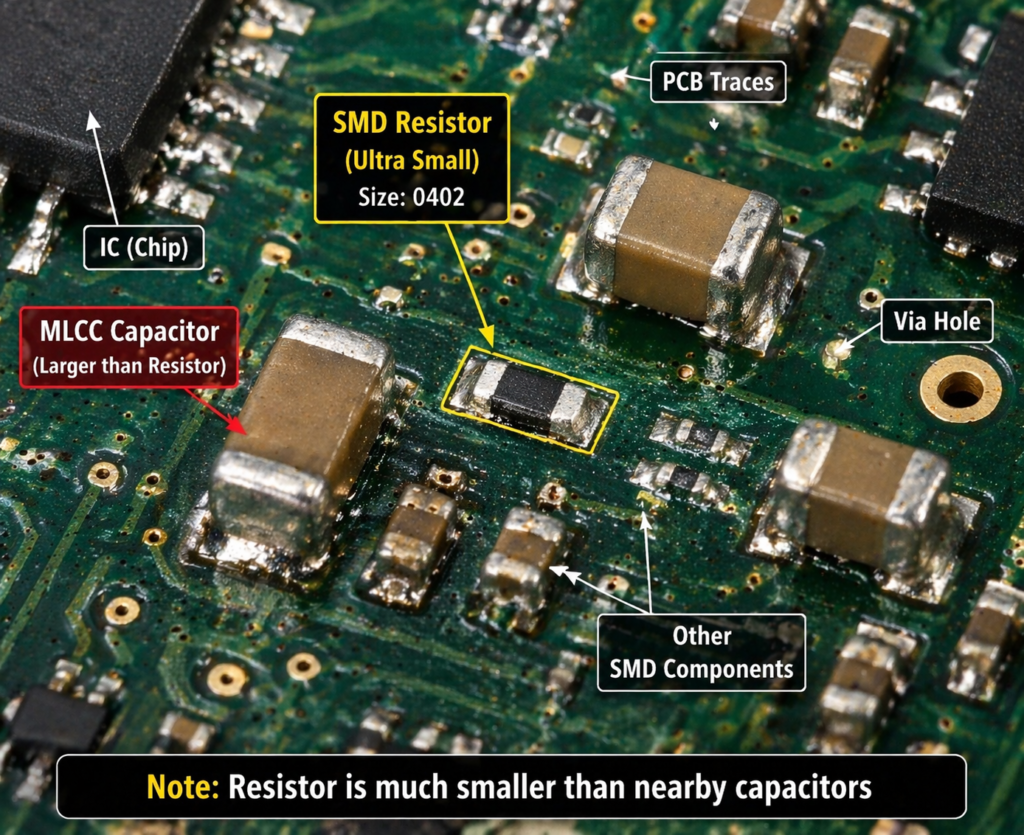
It looks black in color
🔍 Types of Resistors Used in Mobile Phones
1. SMD Resistors (Surface Mount Device)
-
- Most commonly used in smartphones
Very small in size
- Most commonly used in smartphones
-
- Mounted directly on PCB (Printed Circuit Board)
2. Zero Ohm Resistor (Jumper)
-
- Acts like a wire (no resistance)
3. Thermistors
-
- A thermistor is a temperature-sensitive resistor whose resistance changes significantly with temperature.
-
- It is widely used in mobile phones for temperature sensing, protection, and control.
-
- 👉 Simple definition:
Thermistor = Temperature-dependent resistor
- 👉 Simple definition:
Types of Thermistors
🔵 1. NTC (Negative Temperature Coefficient)
-
- Temperature ↑ → Resistance ↓
-
- Most common in smartphones
-
- Used in battery and charging circuits
🔴 2. PTC (Positive Temperature Coefficient)
-
- Temperature ↑ → Resistance ↑
-
- Less common in mobile phones
⚡ Working Principle of Resistor
Resistors work based on Ohm’s Law, which states:
👉 V = I × R
Where:
V = Voltage
I = Current
R = Resistance
✔️ How it Works:
-
- When current flows through a resistor, it opposes the flow
-
- This opposition converts some electrical energy into heat
-
- As a result, current is controlled and stabilized
📲 Functions of Resistors in Mobile Phones
🔋 1. Current Limiting
Prevents excessive current from damaging components like ICs and LEDs.
🔌 2. Voltage Division
Resistors divide voltage into required levels for different circuits.
📡 3. Signal Conditioning
Used in communication circuits to stabilize signals.
🔄 4. Pull-Up & Pull-Down Function
Ensures proper logic levels in digital circuits (HIGH or LOW states).
🔥 5. Protection
Acts as a safeguard against short circuits and overload conditions.
🛠️ Practical Use in Mobile Repair
Common Faults Related to Resistors:
-
- Missing resistor → Circuit not working
-
- Burnt resistor → Overheating issue
-
- Faulty NTC Thermistor → ⚠️ “Battery temperature too high/low” error ,🔄 Boot loop in some cases
-
- SMPS Resistor open or high value →Mobile Dead
-
- Faulty Resistor → Fake Charging
🔧 Checking Resistor with Multimeter (Quick Steps
-
- Set multimeter to Ω (resistance mode)
-
- Ensure phone/PCB is powered OFF
-
- Identify the SMD resistor (small black component)
-
- Place probes on both ends of resistor (no polarity)
-
- Read the value on display
📊 Result Interpretation
-
- ✅ Correct value → Resistor OK
-
- ❌ OL / no reading → Open (faulty)
-
- ❌ 0 or very low → Shorted
-
- ⚠️ Wrong value → Damaged / drifted